Why Is My QuickBooks Payroll No Longer Updating? Causes, Fixes, and Troubleshooting Guide
QuickBooks Payroll is an essential tool for businesses that need to manage employee wages, tax calculations, direct deposits, and payroll records accurately. Keeping the payroll feature updated is important because it ensures you have the latest tax tables, compliance changes, security improvements, and performance enhancements. An outdated payroll system can lead to calculation errors, delays in processing employee payments, and difficulties with tax reporting.
Many users become concerned when QuickBooks Payroll refuses to update. The update may stop unexpectedly, display an error message, freeze during installation, or fail to complete. In some cases, QuickBooks opens normally while the payroll update continues to fail. Although these issues can interrupt your payroll workflow, they are usually caused by software settings, internet connectivity problems, outdated program versions, or corrupted files rather than a major system failure.
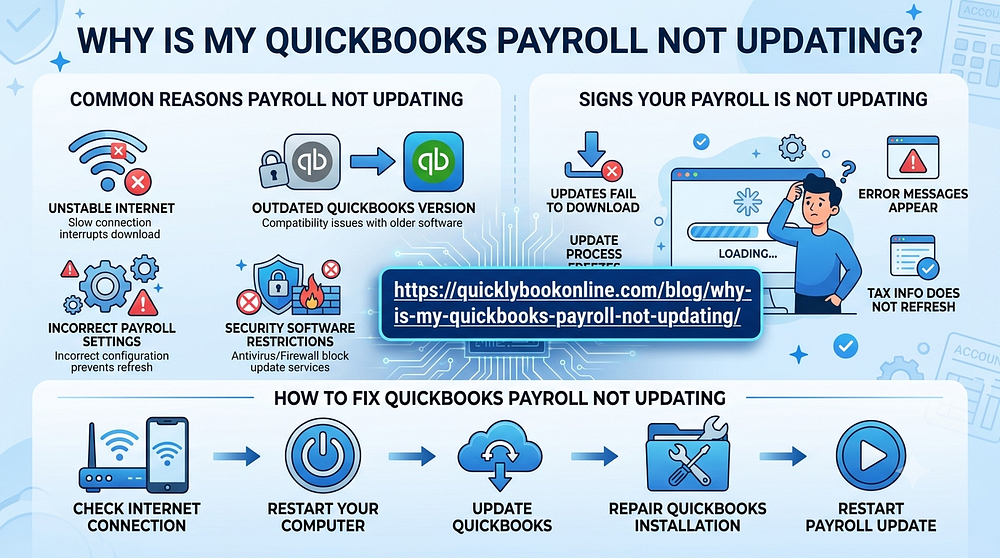
Common Reasons Why QuickBooks Payroll Is Not Updating
Several factors can prevent payroll updates from downloading or installing successfully.
Poor Internet Connection
A slow or unstable internet connection may interrupt the payroll update process.
Outdated QuickBooks Version
Using an older version of QuickBooks can create compatibility issues with payroll updates.
Incorrect Payroll Settings
Improper payroll configuration may prevent QuickBooks from downloading the latest payroll updates.
Corrupted Program Files
Damaged or missing QuickBooks files can interfere with payroll update operations.
Operating System Issues
Missing operating system updates may affect the performance of QuickBooks and its payroll features.
Security Software Restrictions
Antivirus or firewall settings may block QuickBooks from connecting to payroll update services.
Insufficient System Resources
Limited storage space or available memory can interrupt the update process.
Temporary Software Errors
Occasional software glitches may prevent payroll updates from completing successfully.
Signs That Your QuickBooks Payroll Is Not Updating
You may notice one or more of the following symptoms:
- Payroll updates fail to download.
- The update process freezes before completion.
- Error messages appear during the update.
- Payroll tax information does not refresh.
- Employee payroll cannot be processed correctly.
- QuickBooks becomes slow while updating payroll.
- The payroll update restarts repeatedly without finishing.
These signs usually indicate an update-related or software-related issue.
How to Fix QuickBooks Payroll Not Updating
Check Your Internet Connection
Ensure your computer has a stable internet connection before attempting another payroll update.
Restart Your Computer
Restarting your computer refreshes background processes that may interfere with QuickBooks.
Update QuickBooks
Install the latest available QuickBooks updates before downloading payroll updates.
Verify Payroll Settings
Review your payroll settings and confirm they are configured correctly.
Close Background Programs
Close unnecessary applications that may consume system resources during the update.
Check Available Storage Space
Make sure your computer has enough free storage space to complete the payroll update.
Review Security Software Settings
Temporarily review your antivirus or firewall settings to ensure they are not blocking QuickBooks from connecting to update services.
Restart the Payroll Update
After completing the troubleshooting steps, start the payroll update again.
Repair the QuickBooks Installation
If program files are damaged, repairing the QuickBooks installation can restore missing or corrupted components.
Verify the Update
Once the update is complete, confirm that the latest payroll information has been installed successfully.
Tips to Keep QuickBooks Payroll Updated
Following these best practices can help maintain reliable payroll performance.
- Keep QuickBooks updated regularly.
- Maintain a stable internet connection.
- Install operating system updates promptly.
- Perform regular company file backups.
- Close unnecessary programs before updating payroll.
- Maintain sufficient free storage space.
- Review payroll settings periodically.
- Restart your computer regularly.
- Monitor payroll update notifications.
- Perform routine QuickBooks maintenance.
Common Mistakes to Avoid
Avoid these common mistakes when updating QuickBooks Payroll.
- Ignoring QuickBooks software updates.
- Using an unstable internet connection.
- Interrupting the payroll update process.
- Allowing your storage space to become full.
- Ignoring payroll warning messages.
- Running multiple resource-intensive applications during updates.
- Skipping regular company file backups.
Avoiding these mistakes helps reduce payroll update failures and improves overall software performance.
Frequently Asked Questions (FAQs)
Why Is My QuickBooks Payroll Update Failing?
This may happen because of an unstable internet connection, outdated QuickBooks software, incorrect payroll settings, corrupted program files, or antivirus and firewall restrictions.
Should I Update QuickBooks Before Updating Payroll?
Yes. Installing the latest QuickBooks updates improves compatibility and helps payroll updates install successfully.
Can Antivirus Software Prevent Payroll Updates?
Yes. In some cases, antivirus or firewall settings may block QuickBooks from completing the payroll update process.
Why Does the Payroll Update Freeze?
The update may freeze because of software conflicts, limited system resources, damaged files, or temporary software issues.
How Can I Prevent QuickBooks Payroll Update Problems?
Keep QuickBooks updated, maintain a reliable internet connection, install operating system updates, perform regular company file backups, review payroll settings periodically, and avoid interrupting the update process.
Conclusion
If your QuickBooks Payroll is no longer updating, the issue is often related to internet connectivity, outdated QuickBooks software, incorrect payroll settings, corrupted program files, security software restrictions, or temporary system errors. Fortunately, most update problems can be resolved by checking your internet connection, updating QuickBooks, reviewing payroll settings, restarting your computer, and repairing the software when necessary. Following these best practices will help ensure your payroll stays current, accurate, and ready for every pay period.


Comments
Post a Comment